November 18, 2013

WHAT POPULATION PROBLEM ?


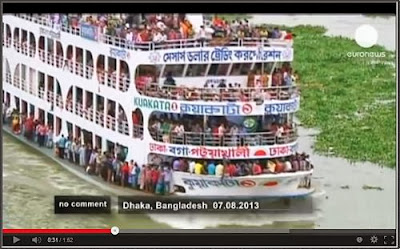
Look at the rush-hour traffic - those crowds in Bangladesh don't even realize that this is NOT a normal way of life.
This can never happen to us ? That's exactly what they thought.
Just give it some decades - it is creeping slowly - but surely.
What will come first to Florida -
*1) The sea-level rise type of boat travel ? Water, water everywhere -
*2) Or the left-over dry-land mass transit type of travel ?
Just take your pick and look at this short documentary video - CLICK pictures below for it.
Over-population ? Naaaah, just a usual rush-hour traffic:
ALL ABOARD !

*1)   http://safeshare.tv/w/vwncRciSFb
*2) http://safeshare.tv/w/vwncRciSFb


November 15, 2013

SECURE FRESH WATER

Florida fresh-water situation was being addressed in the recent article
"Don’t let drought catch Florida by surprise” by Melissa Meeker, the former Executive Director of the SFWMD. A good constructive rumination. However, there is a shortcoming of it being somewhat narrow-minded in a sense that she is not considering / addressing / mentioning at all:


(1) SUSTAINABILITY – While technological advances are making the RO membrane processes somewhat cheaper, desalination technologies are invariably extremely ENERGY intensive.  Their use makes us MORE DEPENDENT on conventional (oil) and controversial (nuclear ?) energy production.  Reverse osmosis membranes are also hydrocarbon based.  Moreover, the newer technologies (RO desalination, ASR, reuse) are still facing some challenges (brine disposal, arsenic contamination and water recovery, public acceptance, mismatch between supply and demand, etc.) when compared to using groundwater.  Check the costs below.  Like a proponent of seawater desal that she appears to be, Ms Meeker seems to somewhat suppresses the outstanding controversies.
While the word “diversification” is being used, let’s make that “sustainable diversification” !

(2)  THE STATE IS not CONSERVING WATER – while public is exhorted to CONSERVE  (SFWMD, FDEP, EPA campaigns).  Water conservation is an extremely important factor. 

How to explain to the public that during a wet year like 2013, instead of storing every drop of water, billions of gallons of freshwater are not only dumped to the estuaries but also causing immeasurable damages there.
What a double-whammy waste of our precious freshwater resource !

(3)
CLIMATE CHANGE and SEA-LEVELRISE – real longer-term danger of inundation does loom on the horizon. While it is not even mentioned, it is already putting an extra pressure on FL fresh water supplies through (underground) penetration of salt water that poisons FL wells supplying the most dense populations of the East and West coasts.


(4) EVERGLADES RESTORATION – results in both natural aquifer recharging and water STORAGE. It is in progress and should be first on the list of remedial alternatives as it will 
a) decrease the need for expensive water desalination, 
b) recharge our aquifers during the wet years, 
c) stop damaging freshwater dumping into the estuaries,

d)
Liven up the tourism and economy in general through available clean water and clean oceans (a $4 return on each $1 so invested).


Obviously, this alternative would not provide freshwater for free.  The costs involved are significant – but it has to be done if Florida is to remain habitable for the population that already arrived and settled in that requires fresh water to survive as a civilization.  
The alternative is to evacuate 8.5 million people of South Florida.

JOB LOSSES due to water shortages are mentioned. What needs to be emphasized is the serious damage due to water shortages and pollution which are deadly destructive to the very heart of the Florida main economic engine – tourism.
The key two sectors with the highest use of our freshwater are public and agriculture.  Floridians used an estimated 6.8 billion gallons per day of freshwater in 2005 and the forecast water demand is around 8.7 billion gallons per day in 2025, mainly subdivided between agriculture (around 2.5 BGD) and public water supply (around 3BGD).  As the industrial/commercial sectors are not high water users, water related job losses in that direction would not be as dramatic compared to people leaving the state, or not visiting it, because of drastic water shortages and water/ocean contamination.


 There is no “free fresh-water” – we end up paying for it one way or another. 
As usual, not one, not two - but ALL factors contributing to the security of our fresh-water supply have to be considered, exploited and introduced to remedy the situation:


GW =Ground Water       SW = Surface Water
RW = Reused Water       WW= Waste Water
 These are, water -
CONSERVATION,
STORAGE,
RE-USE, and
SEAWATER DESAL.

While the engineering and design of well chosen options should be bold and forward-looking, the economics of these alternatives has to be seriously worked out to provide for a solid decision making basis.  SUSTAINABILITY in particular and CLIMATE CHANGE factors have to be also considered as part of the multifactorial, multifaceted and balanced action toward the optimal solution that we could afford as we must act. 
There is no life and no economy without fresh water.


November 1, 2013

WHAT NEXT ?

The Everglades ecosystem encompasses a system of diverse wetland landscapes that are hydrologically and ecologically connected across more than 200 miles from north to south and across 18,000 square miles of southern Florida. Now, what next for the Everglades restoration ?
The governments remind us that a number of restoration projects have been accomplished or are in different stages of progress (read the Fact Sheets). While there is more improvement studied and on drawing boards, the projects are looking for the essential funding. Yes, it all costs money and different stake-holders are outdoing each other – standing “for” as well as “against”. As customary, lobbying is in overdrive.
Given both the cloudy current economic situation and with the current Florida legislators not very environmentally inclined, perhaps it is time to regroup and reflect – what should be the next priorities and steps toward effective Everglades restoration that, as almost everybody in general agrees upon, is needed ?
Let’s take a summarizing and appropriately far-looking and fundamental overview. An Everglades restoration reminder and a wish-list, if you will. Proceeding from North to South, as the Everglades waters (used to) flow, let’s summarize the main tasks as experts tend to see them:

(1) Northern LO Watershed - focus mainly on pollution preventative measures:
Watersheds of LO are mainly
agricultural and cattle grazing lands
● Introduce and enforce strict measures in the form of effective farm BMPs with teeth.
● Introduce and promote the nutrient reduction credit trading.
● Regulate and restrict the uncontrolled urban sprawl and excessive development.
● Enforce effective urban sewage treatment, minimizing the nutrient discharges.

(2) Lake Okeechobee – the liquid heart of Florida is seriously impaired and cleaning up its watershed (above) will certainly help. However, there are tons of “legacy phosphorus” in its mud deposits that should be gradually “removed”. At present, the question of devising the best way of doing so remains outstanding.
Lake Okeechobee is the largest Florida freshwater reservoir. Its primary function could be seen as such, despite the Lake’s ecological function that might have to be only considered as secondary.  Correspondingly, as the crucial flood prevention measure –
● the overhaul and reinforcements of Hoover Dike around the Lake is mandatory.
Florida unusual and extreme seasonal rain variations call for both reliable flood protection and extraordinary water storage capacity.
● Eco-regulation of optimal Caloosahatchee and St. Lucie Rivers water releases.

(3) EAA – There are 3 major problems there caused by intensive agricultural activities:
(a) soil exhaustion that is compensated for by current excessive use of fertilizers;
(b) runoff of major portion of fertilizers applied that pollutes the downstream waters and overloads the existing STAs;
(c) soil oxidation and subsidence to the underlying rock in large areas (more than 3 feet subsidence).
Correspondingly, multi-prong actions are required to remedy the situation:
● Introduce and enforce strict measures in the form of effective farm BMPs with teeth.
● Enforce the Florida Constitution amendment that allows for the “polluters pay” mode of clean-up
● Consolidate land holdings and allocation (“land swap”) for enlargement of existing STAs (with reservoirs – FEBs) and/or new FEB-STA construction.
● Restore and replenish the subsided soil, (using LO muds ?) increasing its levels.

● Provide for clean water sheet-flow south towards the ENP and Florida Bay.
● Extend the Tamiami Trail elevated bridging.
● Control water seepage in the easterly areas of South Florida.
● Take appropriate steps to minimize the salt water underground advance/penetration.

Enough ? Let’s get down to work -


September 9, 2013

LAKE "O" Water Releases :


Self explanatory - what a harmful waste of precious fresh water !


September 3, 2013

BE BOLD !

So we have seen the Florida Senate Select Committee on the Indian River Lagoon and Lake Okeechobee Basin (IRLLOB) in action.  The keeners could follow the show for a whole day – in person or on live video.  The Committee was formed as a response to howling residents of mainly around the Florida east coast Indian River Lagoon that is being inundated by discharges from Lake Okeechobee. Billions of gallons of polluted and tea-colored water creating havoc along the St. Lucie River and killing the Lagoon where those quantities of fresh water just should not be.  They support toxic algal blooms and kill the salinity-sensitive sea life.  While the east coast gets only one quarter of LO water releases, three quarters are streaming down the Caloosahatchee to the west.  We have read and heard all about the ensuing troubles -
East coast lagoons are
overpowered by toxic algae

But that water just has to go somewhere since Lake Okeechobee cannot hold all that falls from the sky during the famous Floridian wet summer. It was particularly watery this year.  Protective Hover Dike around Lake Okeechobee  is unreliable to the point of potentially giving way as the LO water level rises. That would be a major disaster.  What to do ?
Chairing Florida Senator Joe Negron was relentlessly and pragmatically pushing for an immediate fix for the problem. Imagine, as if there could be such a thing after almost a century of hard and diligent work on having the center of Florida drained and mainly taken over by the agriculture and exploding population.
Now – stop the water releases – reverse time – and pronto !
There are some remediation steps that could be taken relatively quickly. They may help some but they do not solve the current problems. Undoing our fathers and grandfathers mistakes - those solutions, involving diverting truly huge quantities of water, are time consuming and expensive. Contemporary science knowledge is telling us what is necessary.  We just have to be bold enough – and do it.  Of course that there will be a bottom line with a dollar sign on it.  We, or some segments of Florida population, benefitted for long enough – and now is the time to pay the piper. And as the issue demonstrates, it is urgent.
Good senator Negron’s Committee heard the solutions – some quick, some slow – all relatively ‘expensive’.  It really takes smarts and some boldness and imagination to make sense out of it all. Amidst shouts of “move it south – move it south !” (meaning water from LO), the senator asked a good question –
What are the barriers for water flowing south ?
Tamiami Trail bridge
under construction
Are they physical and/or legal ??  Actually, there are both.  For water quantity, the downstream ‘plug’ has to be removed first for water to eventually flow south. This represents elevating section(s) of the Tamiami Trail ‘dam’ and putting it on bridges. That construction is moving ahead. However , LO water would still not be allowed to flow south – it is not clean enough ! 

In practical terms, that represents a legal hurdle – maximum 10 ppb of phosphorus has been agreed upon by a Consent Decree for water quality. The Everglades National Park (federal) should  not be fed “dirty water”. This is a serious quality matter and a big legal mine-field.  Water quality is judged by a complicated procedure based on a number of “exceedences” in the predetermined amount of phosphorus to enter.  That is determined by a complex formula specified in Appendix “A” of the Everglades Settlement Agreement.
Experts are now hard at work trying to determine what would be the effect of moving LO (and other) water down south. It is about the effect on the frequency and size of phosphorus “exceedencies”.  This was something the IRLLOB could not quite discern in the discussion – it could be called the “legal plug”. Its removal will require cleansing the water before it is allowed to flow south – meaning new land for construction and operation of reservoirs and STAs. Necessary, but an expensive and definitely not a short-term proposition !
One thing is for sure – the huge quantities of water to be handled (and other practical factors) render ideas of water storage on land (water farming) into the category of “band-aids”.
In terms of expedient (partial) solutions for the meantime, the senator would have to be very bold to consider some unconventional solutions for the grave situation.
Among those in the feedback provided to  the IRLLOB were:
● First of all - stop “studying”, encourage and expedite “doing” – and stay with it.
● Declare the State of Emergency to allow for special procedures and funding.
● Use the “Eminent Domain” approach to obtain the necessary land faster and at reasonable price.
● Dredge new inlets into the Indian River Lagoon to allow for access of more salt water.
● Consider pipelines and dispersal systems for off-shore sea discharge of the LO water.
● Raise water levels in the EAA for extra water storage.
● Enforce BMPs for LO watersheds with a strict control of phosphorus applications.
● Broaden septic tank rules to prevent leakage into ground water.
● There are plans, designs and specific projects, vetted and well discussed – such as CEPP, CERP, LORP, etc.etc.  Expedite them and secure adequate funding.
Enough ?
As usual, not just one of these –ALL these factors mentioned above should be worked together.
And all this considering the East as well as the West coast.
Go ahead – be bold – at least as much as Governor Broward was when he started all this mess – a 100 years ago.  But we don’t have all this time to doodle around – the rains, toxic algal blooms, the hurricanes are coming next year again. And every year !